- Connect SoCal
- Inclusion, Diversity, Equity & Awareness
- Programs & Projects
- Housing
- Economy & Demography
- Federal & State Compliance
- Sustainable Development and Resilient Communities
- Transportation
- Active Transportation
- Planning For Main Streets
- Aviation Program
- Regional Pilot Initiatives Program
- Future Communities Pilot Program
- Transportation Demand Management
- Transit Program
- FreightWorks
- Passenger Rail Program
- Corridor Planning
- Transportation Safety
- Transportation Finance
- Intelligent Transportation Systems
- Southern California Transportation Study
- LA28 Games Mobility Program
- Local Resources
- Funding & Programming
- Legislation & Advocacy
- Publications & Reports
Programs & Projects
SCAG serves as the regional forum for cooperative decision-making by local government elected officials and its primary responsibilities in fulfillment of federal and state requirements include the development of the Regional Transportation Plan and Sustainable Communities Strategy; the Federal Transportation Improvement Program; the annual Overall Work Program; and transportation-related portions of local air quality management plans.
SCAG’s other major functions include determining the regional transportation plans and programs are in conformity with state air quality plans; periodic preparation of a Regional Housing Needs Assessment; and intergovernmental review of regionally significant development projects.
Housing and land use are essential components of effective regional planning. SCAG’s role in advancing housing solutions has increased significantly in recent years, and includes providing funding, resources, data, and technical assistance to support cities and counties, and innovating to realize the region’s housing goals.
SCAG’s Connect SoCal 2024 Regional Transportation Plan/Sustainable Communities Strategy provides a unifying vision for the future, including strategies to achieve housing targets alongside transportation and sustainability objectives.
SCAG has a state-mandated role to develop the Regional Housing Needs Assessment as part of the periodic process to update housing elements of local general plans.
SCAG is committed to supporting housing equity, increasing housing supply and affordability, aligning housing with transportation and sustainability, increasing housing diversity and choice, and advancing financial tools.
SCAG advocates at the state level to influence housing legislation that impacts the region. Those efforts are outlined in more detail on SCAG’s Legislation webpage.
Get the latest information on SCAG’s Southern California economic and demographic data, along with analysis and resources.
- Related Links & Resources
Imperial Valley Economic Development Corporation
The Imperial Valley Economic Development Corporation is a partnership between Imperial County, local cities, elected officials and utilities, united by the common vision of expanding and diversifying the regional economy.Inland Empire Economic Partnership
The Inland Empire Economic Partnership is the area’s only regional economic development organization, which works closely with business and government leaders to make the Inland Empire a great place to live, work and invest.Orange County Business Council
For over 25 years, Orange County Business Council has been the leading voice of business reinforcing the economic influence of Orange County.Southern California Leadership Council
Formed to meet this challenge, the Southern California Leadership Council was founded in 2005 as a non-partisan, non-profit, business-led public policy partnership of business and community leaders.
SCAG is responsible for fulfilling certain state and federal requirements, including, among others, applicable requirements related to the following federal programs. Visit program pages to learn more.
Sustainability and resilience intersect multiple areas of SCAG’s regional planning work, including land use, transportation, housing, and economic development. Agency efforts across each of these issue areas achieve broader sustainability goals from the Connect SoCal Regional Transportation Plan/Sustainable Communities Strategy, such as reducing greenhouse gas emissions. This section focuses primarily on SCAG’s sustainable and resilient development initiatives related to land use, natural hazards, and climate change.
As the designated metropolitan planning organization for Imperial, Los Angeles, Orange, Riverside, San Bernardino and Ventura counties, SCAG is mandated by the federal government to develop a multimodal long-range transportation plan that provides a 20-year vision for investing in our transportation system, and update it at least once every four years. Our plan, the Connect SoCal Regional Transportation Plan/Sustainable Communities Strategy, addresses all modes of the Southern California transportation system, and reflects research and policy initiatives from each mode: active transportation, aviation and airport ground access, corridor planning, goods movement, high-speed rail, intelligent transportation systems, safety and security, transit, and transportation finance.
- Transportation Trends Report
- Image
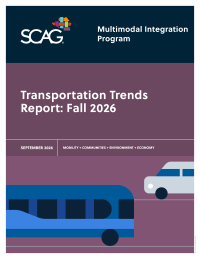
The SCAG region is home to a diverse and expansive mobility ecosystem, with public transit operators delivering services that span local fixed-route bus systems, regional transit networks, intercity services, and commuter rail—reflecting the region’s varied geography and population density.
SCAG releases the biannual “Transportation Trends Report” to provide a timely assessment of transit ridership statistics, roadway performance measures, and telework patterns.
To complete the latest version of this report, SCAG analyzed data through June 2026 for a core subset of transit agencies that represents a cross-section of public operators, including municipal systems, joint powers authorities, county transportation commissions, and transit districts.
Read the Biannual Transportation Trends Report for a complete report on the state of Southern California mobility.